

Monsoon outlook offers hope amid drought concerns

KANE COUNTY — After a winter marked by poor snowpack and worsening drought conditions across Utah, forecasters say this summer’s monsoon season could bring some much-needed moisture to southern Utah, though experts caution it is unlikely to erase long-term drought concerns.
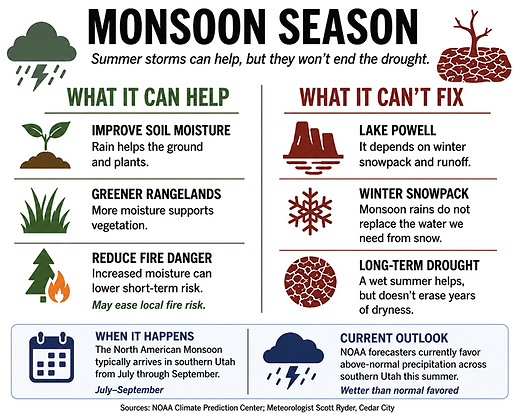
The North American monsoon typically develops during July and August as moisture moves north from the Pacific Ocean and Gulf of California, increasing the likelihood of afternoon thunderstorms across Arizona, Utah and other parts of the Southwest.
Recent outlooks from the National Oceanic and Atmospheric Administration’s Climate Prediction Center favor wetter-than-normal conditions across much of southern Utah this summer. Some forecasters have pointed to warming Pacific Ocean conditions and the potential development of El Niño as factors that could support increased moisture across the region.
Meteorologist Scott Ryder of Cedar City said early signs of monsoon development are beginning to appear across Arizona, although he emphasized that the season is still in its early stages. Ryder said the placement of a summertime high-pressure system over the Four Corners region will play a major role in determining how much moisture ultimately reaches southern Utah.

“The monsoon usually starts to kick in in early July,” Ryder said in a recent forecast video, noting that southwest Utah typically begins feeling its effects by mid-July.
For Kane County residents, an active monsoon could bring greener rangelands, improved soil moisture and a temporary reduction in wildfire danger. At the same time, heavy thunderstorms can create dangerous flash-flood conditions in slot canyons, washes and backcountry roads throughout the region.
Even if rainfall exceeds normal levels, experts caution that summer thunder storms are not a cure for long-term drought. Major reservoirs such as Lake Powell depend primarily on winter snowpack and spring runoff, meaning a wetter monsoon would likely provide local benefits without fully reversing broader water-supply concerns.
Whether this year’s forecast pans out will become clearer over the coming weeks as the monsoon pattern typically strengthens across the Southwest during July and August.


