

Crowd sharply challenges Willow feasibility study at January 7 public hearing

About 300 residents filled the Kanab Center on January7, for a public hearing on the proposed preliminary incorporation of Willow, a large development east of Kanab. Speakers raised objections to the state-required feasibility study and broader concerns about growth, infrastructure and local control.
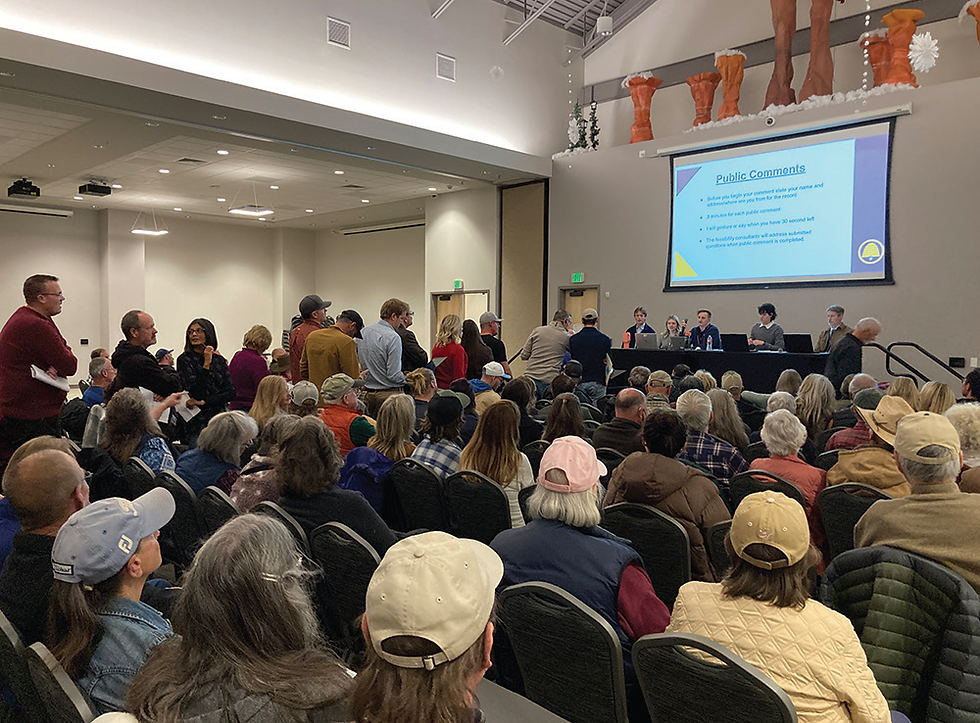
The hearing was part of a statutory process overseen by the Utah Lieutenant Governor’s Office, which reviews incorporation proposals under state law. No decisions were made at the meeting.
Consultants from Lewis Young Robertson & Burningham, now operating as LRB Public Finance Advisors, presented the preliminary feasibility study, which assumes Willow would incorporate as a town and evaluates projected population, service costs, revenues and fiscal impacts over a five-year period.
Early public comment focused on technical challenges to the study’s assumptions. Several speakers, including licensed and certified representatives of the local public board of health responsible for overseeing wastewater systems, raised concerns about the proposal’s reliance on individual septic systems, saying the proposed lot sizes may not be sufficient to meet state requirements.
Fire protection was a central issue throughout the hearing. The feasibility study assumes service would be provided through the Vermillion Cliffs Special Service District, a county-created entity established in 2025 to serve unincorporated areas near Kanab. Speakers and local officials noted that the district was only recently formed and does not have personnel, equipment or operational capacity to provide fire protection directly, with its authority limited to contracting for services.
Kanab City officials have previously notified the lieutenant governor’s office that the city cannot provide fire protection services to the proposed development under the assumed structure. Kane County Commissioner Celeste Meyeres said she agreed and questioned whether the feasibility study adequately accounted for the true cost and practicality of fire and emergency services.
Meyeres also cited infrastructure costs she said were missing or understated in the analysis, including sewer systems, a potential Highway 89 turning lane and costs related to impact fees, warranties and bonding. She noted that power service, which would be provided by Garkane Energy, was not addressed in the presentation.

County Attorney Jeff Stott said he did not believe the feasibility study fully aligned with the project’s certified plan. Questions were also raised about revenue assumptions tied to commercial development and hotel use.
After prepared speakers concluded, public comment became more emotional. Residents questioned water availability, road capacity, fire protection and population growth projections, with several expressing skepticism that the development would fill as projected.
LRB representatives said the proposal includes provisions allowing the county to seek damages if the development fails, though residents continued to voice concern about who would ultimately bear municipal costs.
Speakers also raised concerns about population density, property values, affordability, dark skies, traffic and impacts to the area’s rural character.
Rep. Logan Monson, who represents the district, spoke during public comment and said he opposed the preliminary incorporation process being used for Willow, not traditional incorporation methods. Monson said he supported and voted for legislation backed by the Kane County Commission last year that would have paused preliminary municipality filings while the process was reviewed and refined.
While several speakers acknowledged that the incorporation process is governed by state law and now largely outside county control, many said that reality made the proposal especially difficult to accept, describing it as an erosion of local self-governance.
No action was taken at the hearing. The incorporation process will continue through state review, including potential signature gathering and further steps outlined in statute.


